
Andean cosmology encompasses the ways different Andean peoples understand the universe and the relationships among humans, mountains, earth, celestial bodies, and sacred beings. In the Peruvian Andes, these traditions connect spiritual life with agriculture, community responsibilities, and the landscapes people inhabit. Understanding this worldview offers travelers a deeper perspective on places such as Cusco, Ausangate, and the Sacred Valley.
Rather than a single belief system shared identically across the mountains, Andean cosmology includes diverse traditions that have developed over centuries. Inca religious practices form part of this history, alongside earlier cultures and the beliefs of contemporary communities. This distinction matters when exploring a region where archaeological heritage and living cultural practices exist together.
The following seven themes introduce this cultural landscape, explaining essential concepts while recognizing that meanings vary between communities, historical periods, and sources.
1. What is Andean cosmology?
To understand Andean cosmology, begin with relationships. Mountains provide water, agricultural work depends on seasonal changes, and households rely on cooperation. Within many Andean traditions, these connections also carry spiritual meaning: people have responsibilities toward the beings and places that sustain their lives.
This perspective helps explain why a mountain may be understood as more than a geographical feature or why cultivating a field can involve both practical knowledge and ritual activity. The physical environment, social relationships, and sacred life can overlap rather than operate as entirely separate categories.
How nature, community and the sacred are connected
For visitors, the landscape often appears first as scenery. For local residents, the same place may hold family memories, grazing rights, agricultural responsibilities, and sacred associations. Understanding these overlapping meanings changes how travelers interpret what they see.
A spring, for example, can provide drinking water while also holding cultural significance. A mountain pass may connect settlements and carry meanings expressed through stories or locally observed practices. The significance comes from particular relationships with that place, rather than from a universal explanation applied to every Andean landscape.
A useful starting question is therefore: “What does this place mean to the people who live here?” Listening to different answers offers a fuller introduction than searching for one fixed definition.
Andean traditions before, during and after the Inca Empire
Andean cosmology did not begin with the Incas. Their empire developed within a region already shaped by earlier societies, and Inca religious organization incorporated inherited knowledge alongside imperial institutions. Research on Inca astronomy highlights this combination of earlier traditions and knowledge gathered through expansion.
The terms “Andean” and “Inca” should consequently be used with care. “Inca cosmology” refers more specifically to beliefs associated with Inca society and rule. “Andean cosmology” provides a broader framework that can include other historical traditions and contemporary practices.
For travelers, making this distinction prevents the assumption that every ceremony, textile, or community custom is an unchanged survival from the empire.
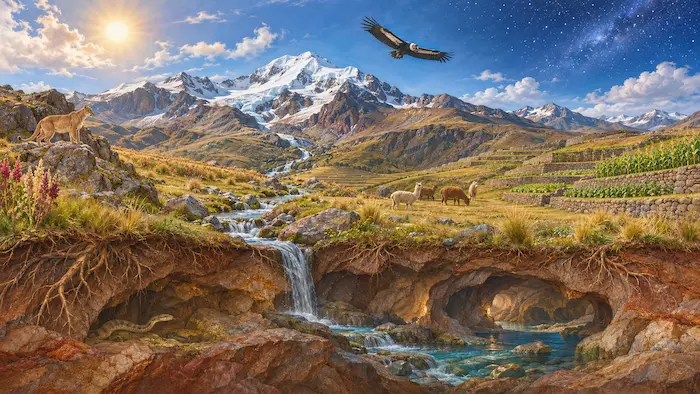
2. The three worlds in Andean cosmology
One familiar introduction to Andean cosmology describes three interconnected worlds: Hanan pacha, Kay pacha, and Ukhu pacha. This framework appears in museum explanations of Inca beliefs, although spelling and interpretation differ between sources. The word pacha can involve ideas of world, space, and time, making a single English translation incomplete.
These concepts are best approached as an introductory model. They should not be treated as a complete map of every Andean community’s understanding of existence, nor automatically equated with Christian ideas of heaven, earth, and hell.
Hanan pacha: The upper world
Hanan pacha is generally described as the upper world, associated with the sky, stars, and celestial beings. It directs attention toward a domain that people could observe through the changing heavens while understanding it through sacred relationships.
For readers encountering Andean cosmology for the first time, “upper world” is a useful translation. However, it does not mean that every historical source defines its inhabitants or boundaries identically.
Kay pacha: The world of everyday life
Kay pacha refers to the world of present, everyday existence. It includes the places where people work, cultivate crops, raise animals, and maintain social relationships.
Describing it simply as the “human world” can be limiting. The National Museum of Archaeology, Anthropology and History of Peru also describes this realm as one in which everyday activities coexist with spirits associated with mountains. Ordinary life and sacred presence are therefore not necessarily separate.
Ukhu pacha: The inner world
Ukhu pacha, also written Uku pacha, is commonly translated as the inner or below-ground world. Introductory accounts associate it with the dead and subterranean places, including caves.
Calling it “hell” introduces an equivalence that can distort the concept. A more careful explanation retains the idea of an inner realm while acknowledging differences between historical descriptions.
| Concept | Common introductory translation | Main association | Reading tip |
| Hanan pacha | Upper world | Sky and celestial beings | Avoid assuming it means Christian heaven |
| Kay pacha | This world | Everyday existence and relationships | Sacred presence can overlap with daily life |
| Ukhu pacha | Inner world | Subterranean places and the dead | Avoid reducing it to punishment or evil |
The table summarizes a teaching framework rather than a universal doctrine.
3. Pachamama and the relationship with the earth
Pachamama is among the most widely recognized concepts associated with Andean cosmology. Often translated as “Mother Earth,” the term introduces relationships involving land, sustenance, and human obligations. Its meaning deserves more attention than a brief reference to nature or environmental awareness.
Historical research examines references to Pachamama in sixteenth- and seventeenth-century chronicles, including representations, beliefs, and rituals connected with the earth. These accounts provide valuable evidence, while requiring interpretation within the circumstances in which colonial authors recorded them.
What Pachamama means in Andean traditions
“Mother Earth” offers an accessible starting point, but translating a culturally specific concept into familiar English can hide some of its complexity. Readers should avoid assuming that the phrase explains every relationship, practice, or local understanding associated with Pachamama.
When encountering an offering or hearing a guide’s explanation, useful questions include who carries out the practice, what occasion it marks, and whether visitors are welcome. These details make the explanation specific and grounded.
Travelers should also distinguish between learning about a tradition and being invited to participate. Interest alone does not provide access to every ceremony, and observing respectfully may be the appropriate response.
Reciprocity and the practice of ayni
Ayni is commonly explained through reciprocity: assistance creates relationships involving mutual responsibilities. The Smithsonian’s National Museum of the American Indian presents it as an important principle in Andean life, including cooperation in maintaining infrastructure and managing shared resources.
This offers a practical way to approach Andean cosmology. Relationships involve what people contribute as well as what they receive. Thinking about reciprocity moves the discussion beyond symbols toward everyday cooperation.
For travelers, the concept invites reflection rather than imitation. Paying fairly, respecting agreements, and listening to hosts are concrete choices. They should not be presented as equivalent to participating in a community’s own system of ayni, but they can support more considerate encounters.
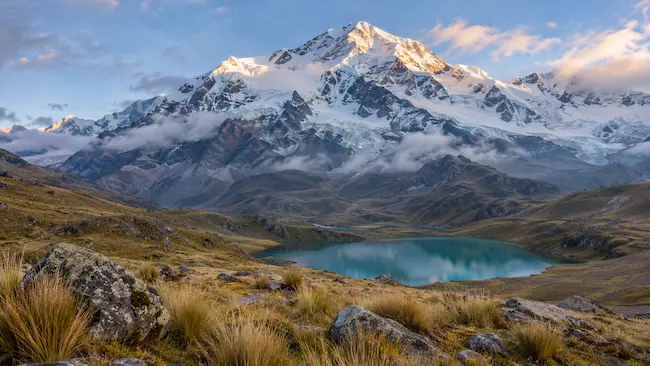
4. Apus and the sacred meaning of mountains
Mountains are central to many visitors’ experience of Peru, yet their cultural significance cannot be measured through altitude alone. Discussions of Andean cosmology often introduce apus in connection with powerful mountains and the beings associated with them.
Ethnographic research on Quechua communities around Cusco examines mountain and earth worship within particular local settings. This specificity matters: an explanation drawn from one community should not automatically be applied to the entire Andes.
What apus represent in local Andean beliefs
The English phrase “mountain spirit” provides a convenient introduction, but it may not fully communicate how a community understands a particular apu. Local names, stories, and relationships deserve attention in their own right.
A useful cultural explanation identifies the mountain and the people whose interpretation is being discussed. It also distinguishes local testimony from a guide’s summary or a modern visitor interpretation.
For someone walking through the Andes, this encourages a different kind of observation. Instead of treating every summit as interchangeable scenery, travelers can ask about the particular landscape surrounding the route and recognize that some knowledge may remain private.
Ausangate and Salkantay in their regional cultural contexts
Ausangate offers an important setting for learning about the relationship between mountains and living religious traditions. UNESCO documentation concerning Qoyllurit’i places the pilgrimage within a mountain landscape where Ausangate has considerable sacred significance. The pilgrimage itself has its own history and community organization.
Travelers considering Ausangate treks can use this cultural background to prepare more thoughtful questions about the region. A trekking itinerary should still be distinguished from a pilgrimage or an invitation to join a religious activity.
Those exploring Salkantay treks can take the same approach: ask guides to explain the mountain’s local cultural context and identify whose stories they are sharing. Respectful interpretation adds depth without promising access to ceremonies or presenting every mountain tradition as identical.
5. The sun, stars and agricultural cycles
Looking upward provides another entry into Andean cosmology. The changing sky offered observable patterns that could be connected with seasonal activities and sacred narratives. In Inca society, astronomical observation also intersected with religious ceremonies and imperial authority.
This combination helps explain why discussions of the sun and stars belong alongside agriculture and community life. Astronomy was not simply a collection of stories about distant objects; it formed part of how people interpreted the world around them.
Inti and the importance of the sun in Inca religion
Inti, the sun, held a central position in Inca state religion. The ruling dynasty’s relationship with the sun supported imperial authority, connecting religious expression with political legitimacy.
Research on Inca sacred sites examines how solar observation related to built spaces and landscape features. This supports a broader understanding of religious practice, in which architecture, horizon observation, and ceremonial activity could work together.
However, the prominence of Inti in imperial religion should not be used to erase other sacred relationships. Learning about the sun provides one part of the picture rather than a complete explanation of Andean belief.
The Milky Way and dark cloud constellations
Some Andean sky traditions recognize figures in the dark areas of the Milky Way, as well as patterns formed by bright stars. The Smithsonian describes the Milky Way as Mayu, a celestial river, and discusses animal figures associated with its dark regions.
For readers accustomed to constellations drawn by connecting points of light, this offers a striking alternative. The darker spaces themselves become meaningful parts of the sky.
Names and interpretations should be attributed carefully rather than presented as identical throughout the Andes. A local explanation can help travelers understand which tradition they are hearing and how the guide learned it.
Seasonal cycles and agricultural knowledge
Andean cosmology becomes easier to understand when readers consider the practical importance of timing. Farming households must respond to changing conditions, and interpreting the environment involves sustained observation.
For visitors, the useful lesson is to pay attention to connections rather than separate “spiritual beliefs” from “practical knowledge” too quickly. A conversation about seasons may also involve farming experience, family teaching, and local explanations of the landscape.
Questions about planting, rainfall, or animal care can therefore open a more grounded discussion than asking only about myths. Travelers should allow residents to decide what they wish to share, especially when conversations concern livelihoods rather than tourist activities.
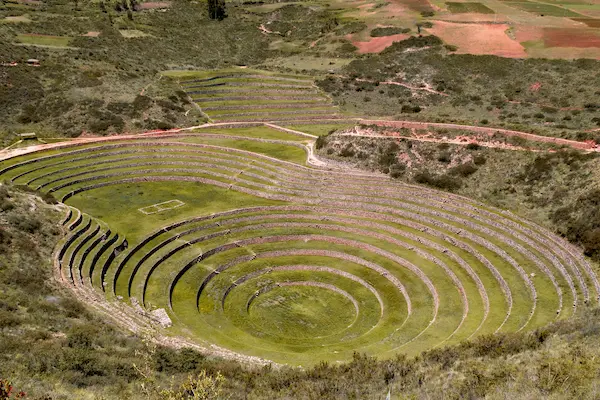
6. Sacred landscapes and places in the Peruvian Andes
Andean cosmology can also change how travelers approach archaeological sites. A stone structure gains context when considered alongside nearby mountains, water, pathways, and the surrounding terrain.
This does not mean that every feature has a known sacred purpose. Careful interpretation distinguishes documented evidence from scholarly hypotheses and popular explanations. Leaving some questions open can produce a more accurate understanding than assigning certainty to every stone.
What huacas are and why they matter
The term huaca, also spelled wak’a, is commonly used for sacred beings, objects, or places in Andean contexts. In research on Inca landscapes, examples include natural features and modified rock formations associated with religious significance.
This helps explain why an apparently modest outcrop may deserve as much interpretive attention as a large building. Monumental size alone does not determine sacred importance.
When visiting a site, ask what evidence supports its interpretation: historical descriptions, archaeological findings, astronomical measurements, or continuing local knowledge. Different kinds of evidence answer different questions and may leave room for debate.
Cusco and the relationship between landscape and sacred places
Cusco provides an opportunity to think about architecture in relation to its wider setting. Rather than viewing individual monuments as isolated attractions, visitors can consider how a site relates to the valley and its horizon.
Research into Inca astronomy examines sacred features around Cusco through their topographical setting, sightlines, and changing light. Such work demonstrates why understanding a place may require looking beyond the structure immediately in front of you.
A thoughtful visit can therefore include simple questions: What is visible from here? Where does water flow? Which features have been studied, and which explanations remain uncertain?
Machu Picchu and the interpretation of its sacred landscape
Machu Picchu invites visitors to consider buildings, stone, and mountainous terrain together. An informed explanation should clarify when it describes visible evidence and when it introduces an interpretation of purpose or meaning.
Avoid assuming that every unusual feature proves a single theory about Andean cosmology. Several interpretations can exist, and some questions may remain unresolved.
For travelers, this uncertainty need not reduce the experience. It creates room for observation: notice the setting, ask how researchers reached a conclusion, and distinguish an engaging story from an established finding.
7. Andean cosmology in living traditions
Andean cosmology also belongs to the present. Contemporary communities make their own choices about religious practice, cultural identity, and what they share with visitors.
Approaching living traditions requires recognizing both continuity and change. The Smithsonian describes the persistence of community values and reciprocity despite centuries of colonial pressures. This continuity does not mean that contemporary people must live exactly as their ancestors did.
Cultural continuity, change and regional differences
Qoyllurit’i illustrates the complexity of living religious heritage. UNESCO describes a pilgrimage bringing together Catholic elements and reverence associated with Andean nature, supported by organized groups and established codes of conduct.
Such traditions deserve to be understood through their participants rather than judged against an imagined standard of unchanged “authenticity.” Cultural change does not automatically make a practice less meaningful.
Visitors should also avoid expecting agreement from everyone they meet. People can hold different beliefs within the same region, community, or household. Listening to those differences gives a more realistic picture of contemporary life.
How travelers can approach local traditions respectfully
Preparation helps turn cultural interest into considerate behavior. Before photographing, joining, or sharing an encounter, establish what is welcome.
Useful practices include:
- Ask permission before photographing people, offerings, or ceremonies.
- Follow local guidance about access and appropriate behavior.
- Avoid touching or rearranging objects for a photograph.
- Accept that some knowledge and activities are private.
- Request clear explanations without pressuring anyone to perform.
- Support fairly compensated local work and services.
- Keep archaeological and natural places free of litter.
These actions do not require travelers to adopt beliefs. They require recognizing that hosts have authority over their own participation, spaces, and cultural expression.
Understanding the cultural landscape while trekking in Peru
On a trek, learning can begin with ordinary details: a place name, a conversation, or a mountain identified by a guide. Ask whether an explanation comes from local experience, historical research, or a broader interpretation.
This approach gives Andean cosmology a human context. It encourages travelers to listen carefully, recognize uncertainty, and value the people whose lives shape the landscapes they visit.
Understanding the Andes through relationships
Andean cosmology offers a way to explore connections among land, sky, sacred presence, and community responsibilities. Its meaning becomes clearer through specific places and people rather than universal claims.
For travelers in Peru, the strongest starting point is curiosity supported by respect. Go Treks Peru invites visitors to approach their journey with thoughtful questions, attention to local guidance, and an appreciation of the Andes as both a remarkable landscape and a living cultural home.


