
Before WhatsApp, the internet and even writing existed in South America, there many civilizations that had already developed a way of communicating. For example, the Inca Empire, one of the most powerful pre-Columbian civilization in America, had its own communication system: the Chasquis. These were young messengers who were train to run all the way in the Tawantinsuyu to delivere oral messages or important items in between territories.
In this post we’ll explore who the Chasquis were, and how important their labour was to the Inca Empire by understanding how they operated and why their system is recognized as one of the most impressive logistical organization of the ancient cultures.
You may also like: Corpus Christi in Cusco 2025: Guide through this religious celebration

Who were the Chasquis?
The Chasquis were the trusted messengers of the Inca Empire, they were young men who where in charge of delivering the most important communications in between towns of the whole Tawantinsuyu. Let’s remember that the Tawantinsuyu was real big territory, it extended to a big part of SouthAmerica, including parts of what today is Peru, Ecuador, Bolivia, Colombia, Chile and even Argentina.
They worked in a relay system across the Qhapaq Ñan, the name of the routes they created to ensure that messages could move quickly from one region to another. Since there were no means of transportation in that time, the Chasquis were elite runners who were chosen by their speed, memory and discipline, their work was one of the most important ones in the administration of the Incas culture. Here are some other characteristics they had:
- Fast and enduring: They could cover over 240 km per day in relays.
- Mentally sharp: Messages were often oral and had to be memorized exactly.
- Strategic thinking: They navigated complex mountain paths with precision.
- Multi-taskers: Besides verbal messages, they carried quipus (knotted cords), small items, and ceremonial goods.
Chasquis definition
In Quechua, the language of the Incas, chasqui means “the one who receives or delivers”. This meaning, highlights completely the importance of their work in the communication chain of these ancient culture. They were not only runners, they were considered as vital links in the structure of power, because they allowed the Inca to stay informed and be able to control correctly the territory, that got to be as big as 2 500 000 km2.
What were the Chasquis like?
Being a Chasqui wasn’t an easy role at all and it wasn’t for everyone, they were typically selected from the sons of local communities and underwent to some really hard training to be able to do the right word- They needed some physical and memory training, and of course, they had to be trustworthy people, because they would be in charge of delivering confidential information. Knowing that, we can highlight these characteristics of them:
- Discipline and dedication: They followed strict routines and couldn’t afford mistakes.
- Excellent memory: A message wrongly passed could lead to military or administrative chaos.
- Youth and health: Only the fittest were chosen, usually teenagers or men in their early twenties.
- Respect and status: In many communities, being a Chasqui was an honor, almost like serving the empire as a soldier.
Chasquis clothes
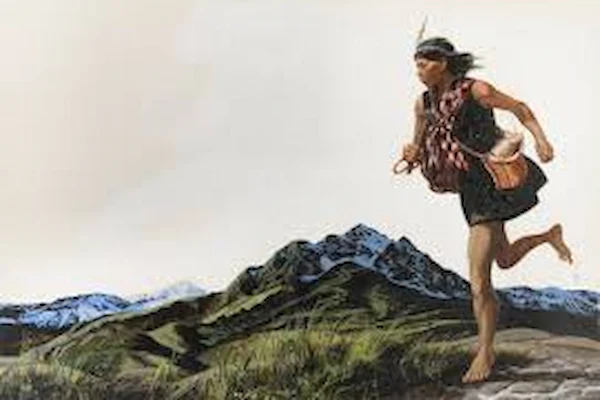
Functionality was key for them, that’s why their clothing was light, sturdy, and adapted to high-altitude running. But it also helped them stand out as official messengers. Their outfit wasn’t ceremonial — it was designed for performance, endurance, and recognition.
Their typical gear included:
- Unku: A sleeveless tunic made of wool or cotton.
- Usuta: Sandals made of leather or plant fibers, perfect for mountain paths.
- Qipi: A small woven backpack for carrying quipus or packages.
- Qhapaq ch’ullu: A colorful knitted cap with earflaps, often used to identify their role.
- Chuspa: A small pouch to carry coca leaves, used for energy and to combat altitude sickness.
The Chasquis system
The system of the chasquis was what really allowed their great performance throughout the years of the Inca empire. Although they were obviously very well trained workers, they also had a system of routes, signs, clothing and functions that allowed for organized and efficient work. Therefore, we will explore a little about this below.
The chasquis work tools
The Chasquis had certain work tools that were essential to them. Here is a list of these:
- The quipus: This was a system of strings and knots on which numerical, accounting and even message information was recorded. They were used to store tribute or census data and were interpreted by specialized people.
- Walking sticks: They also used to have special staffs that identified them as official messengers and indicated their authority.
- Clothes: The right clothes were also a part of their work and helped them to go faster to deliver the messages.
Their functions
As mentioned above, the chasquis were not only messengers, but were also valued as a fundamental piece for the government of the time. Therefore, they had a series of functions that helped the Inca Empire to function and stay in communication. Their main functions were the following:
Delivery of official messages: they transported orders, instructions and written or coded reports from the Inca or his administrators to the different provinces and vice versa. This included messages on administrative, political and military matters.
- Dissemination of news: They carried relevant information such as celebrations, victories, changes in local administration, or important events affecting the communities.Coordination of activities and communal work: They facilitated the organization of collective tasks known as “mita” (compulsory work), convened communities for agricultural projects, construction or ceremonial events, ensuring that participation was timely and effective.
- Coordination of activities and communal work: They facilitated the organization of collective tasks known as “mita” (compulsory work), convened communities for agricultural projects, construction or ceremonial events, ensuring that participation was timely and effective.
- Surveillance and early warning: they acted as a warning system to report external threats such as invasions, rebellions or natural disasters, sending quick signals to prepare defenses or assist in emergencies.
- Communication between distant populations: They were the link between remote communities and the center of the empire, ensuring that information circulated without interruption or error in territories that were often isolated.
- Transport of valuable or ceremonial objects: Sometimes they carried gifts, ritual instruments or materials needed for ceremonies and official events, with the responsibility of ensuring that they arrived intact.
- Logistical support in military movements: They carried instructions for the troops, indicating routes, times and strategies, helping to coordinate military maneuvers quickly.
Sending coded messages using quipus: Some messages included numerical information or complex instructions that could only be interpreted with the proper knowledge, guaranteeing the confidentiality and accuracy of the communication.
Work organization of the Chasquis
The organization of the Chasquis was one of the greatest logistical achievements of the Inca Empire. Their communication system relied on careful planning, physical endurance, and an extensive road network that connected cities, administrative centers, and remote villages across the Andes. Every runner had a specific role, allowing messages, goods, and even fresh products to travel remarkably fast across thousands of kilometers.
1. Relay stations (Tambos)
The foundation of the Chasqui network was a series of relay stations known as tambos, strategically positioned every 4 to 6 kilometers along the Qhapaq Ñan, the vast Inca road system. Each tambo served as a checkpoint where one Chasqui would hand over the message or cargo to the next runner waiting for his arrival.
These relay stations were more than simple exchange points. They also provided food, water, shelter, and a place for runners to recover before their next assignment. Thanks to this organization, the communication network operated continuously without requiring a single messenger to travel long distances.
2. A continuous relay system
Instead of running hundreds of kilometers alone, each Chasqui completed only a short section of the route before passing the message to another trained runner. This relay system allowed information to move almost without interruption, day and night.
Because every messenger specialized in a relatively short distance, they could maintain a fast pace while minimizing exhaustion. Historians estimate that urgent messages could travel more than 200 kilometers in a single day—an extraordinary achievement considering the mountainous geography of the Andes.
3. Communication through visual and sound signals
Coordination between relay stations was essential for maintaining speed. To alert the next runner that a message was approaching, the Chasquis relied on different signaling methods depending on the terrain and time of day.
During daylight hours, smoke signals and loud shell trumpets known as pututus were commonly used. At night, fires or torches helped indicate the arrival of an important messenger. These signals ensured that the next Chasqui was already prepared to begin running the moment the message arrived.
4. The importance of the Qhapaq Ñan road network
The efficiency of the Chasqui system would not have been possible without the Qhapaq Ñan, one of the largest road networks ever built in the pre-Columbian Americas.
Stretching for more than 30,000 kilometers, these roads crossed deserts, valleys, mountains, and cloud forests. Stone staircases, suspension bridges, retaining walls, and carefully engineered pathways allowed Chasquis to move quickly through some of the world’s most challenging landscapes while maintaining reliable communication across the empire.
5. Selection and physical training
Not everyone could become a Chasqui. Candidates were carefully selected for their speed, endurance, and physical condition from an early age.
Training included long-distance running, navigating steep mountain trails, and adapting to extreme weather conditions, including high-altitude environments where oxygen levels were low. Their remarkable fitness allowed them to carry messages across difficult terrain without sacrificing speed or accuracy.
6. Specialized routes and responsibilities
Although all Chasquis shared the same mission, many became specialists depending on the region they served. Some focused on mountainous routes with steep elevations, while others covered valleys, coastal areas, or sections near the Amazon rainforest.
This specialization ensured that each runner was familiar with the terrain, weather conditions, and potential obstacles, helping maintain the efficiency of the communication network throughout the empire.
7. Supervision and administrative control
Behind every successful Chasqui network was a well-organized administrative system. Officials supervised the relay stations, monitored delivery times, and ensured that every message reached its destination correctly.
This level of oversight reflected the sophisticated bureaucracy of the Inca Empire, where communication played a vital role in military operations, trade, tax collection, and the governance of a vast territory. The reliability of the Chasquis allowed Inca rulers to stay informed and respond quickly to events occurring hundreds of kilometers away.
- Postas or Tambos: These were relay points located approximately every 4 to 6 kilometers along the roads. At each post, a chasqui who had run a stage delivered his message or load to the next runner. This prevented excessive fatigue and ensured that there was always someone fresh and ready to continue. In addition, the postas were places where runners could rest and eat.
- Continuous and synchronized relays: This system of stage races allowed information to travel at great speed, with chasquis traveling only small distances, but in a continuous movement without significant pauses. Thus, a message could travel tens or even hundreds of kilometers in a single day.
- Visual and auditory signals: To coordinate and alert at a distance, the chasquis used torches during the night, and smoke or drums during the day. These signals made it possible to anticipate the arrival of an important message or to communicate emergency situations between nearby posts.
- Road network (Qhapaq Ñan): The entire system depended on this complex road network, built with advanced engineering to circumvent mountains, rivers and other natural obstacles. The roads were paved or stabilized and constantly maintained, which facilitated rapid travel.
- Selection and training of chasquis: The chasquis were strong young men, trained from a very young age to run long distances in difficult conditions, including altitude, cold, rain and steep terrain. Their physical preparation and endurance were exceptional.
- Route-specific roles: Some chasquis specialized in high mountain routes, while others covered flat or jungle terrain, adapting their skills to the environment to maintain speed and efficiency.
- Supervision and control: There were supervisors who ensured the proper functioning of the network, controlling that messages arrived correctly and on time, and that relays were carried out smoothly.

Qhapaq Ñan: The Chasquis route
The Qhapaq Ñan, which means “Main Road” in Quechua, was the extensive network of roads built by the Incas to connect their entire empire, stretching from southern Colombia to northern Chile and Argentina. This network totaled more than 30,000 kilometers and crossed the Andes, valleys, deserts and jungles, ingeniously adapting to each terrain.
For the Chasquis, the Qhapaq Ñan was the fundamental route. Thanks to these well-designed and maintained roads, they were able to carry out their relays and transmit messages quickly and accurately. At each post or tambo – stations located at regular intervals – one chasqui delivered the message to another, allowing the information to move forward without pause.
The Inca Trail in Qhapaq Ñan
It is important to clarify that the famous “Inca Trail” or Inca Trail, which today many tourists travel to Machu Picchu, is only a small section within this gigantic network called Qhapaq Ñan. While the Qhapaq Ñan encompasses multiple routes that connected different regions of the empire, the Inca Trail is simply a specific route, well preserved and adapted for modern tourism. Thus, although the Inca Trail is popular and recognized, it represents only a fraction of the vast Inca road system.
You may also like: Qoyllur Rit’i: what you need to know about the snow star festival

The Chasquis after the Spanish conquest
The arrival of the Spanish in the 16th century represented a profound change for the Inca communication system and, of course, for the Chasquis. At first, the conquistadors took advantage of the Qhapaq Ñan road network to move around and control the territory, but the introduction of horses and carts-which were not suitable for the narrow and steep routes-caused significant wear and tear on the roads.
In addition, the system of posts and relays that facilitated the work of the chasquis began to decline. The imposition of new administrative forms and the prohibition or abandonment of traditional practices such as the use of quipus deteriorated the internal communication of the empire. The Spanish implemented European correspondence methods, which relied on written mail and different messengers, gradually replacing the old Inca system.
Although the original system of the chasquis was largely lost, the legacy of the Qhapaq Ñan and these corridors continues. Many routes are still used by Andean communities, and the Inca Trail is a living reminder of Inca engineering and organization. This cultural and historical legacy remains a symbol of the communication and cohesion capacity of one of the largest empires in the Americas.
Why were the Chasquis essential for the Inca Empire?
Without the Chasquis, governing the vast Inca Empire would have been almost impossible.
At its height, the empire stretched across modern-day Peru, Ecuador, Bolivia, Chile, Argentina, and Colombia. Managing such an enormous territory required constant communication between the capital, Cusco, and hundreds of administrative centers.
The Chasquis allowed rulers to receive reports about harvests, construction projects, military campaigns, taxation, and local events in a matter of days rather than weeks. This rapid flow of information helped the Inca government respond quickly to emergencies, organize armies, distribute resources, and maintain political control across thousands of kilometers.
Their work also supported trade and diplomacy, ensuring that important decisions reached even the most remote Andean communities.
Today, historians consider the Chasquis one of the greatest examples of logistical organization in the pre-Columbian world. Their communication system demonstrated that speed, coordination, and teamwork could overcome geographical challenges long before modern technology existed.

How fast could the Chasquis deliver messages across the Inca Empire?
One of the most fascinating facts about the Chasquis is the incredible speed at which they transported information across the Inca Empire. Although each messenger only ran a relatively short section of the route, the relay system allowed messages to travel continuously without long interruptions.
Historians estimate that important messages could cover between 200 and 250 kilometers (125–155 miles) in a single day, an extraordinary achievement considering that the routes crossed some of the highest mountains in the Andes. Instead of relying on one runner to complete the entire journey, every Chasqui sprinted only a few kilometers before handing the message to another trained messenger waiting at the next relay station.
This organization allowed the Inca government to communicate rapidly between Cusco and distant provinces, making the Chasquis one of the fastest communication systems in the world before the invention of modern transportation.
Their efficiency was so remarkable that fresh fish from Peru’s Pacific coast could reportedly reach the Inca emperor in Cusco within two days, despite the enormous distance and rugged terrain separating the two locations.

What did the Chasquis carry?
Many travelers imagine the Chasquis carrying only written messages, but their responsibilities were much broader. They transported anything considered essential for the administration and stability of the Inca Empire.
Among the most important items were quipus, the sophisticated system of knotted cords used to record numerical information and administrative data. Since the Incas did not develop a conventional writing system, quipus were often accompanied by oral messages that the Chasquis memorized with remarkable accuracy.
They also carried military orders, reports from provincial governors, ceremonial objects, medicinal herbs, coca leaves, and valuable goods required by the imperial administration. During important celebrations or political events, they even transported fresh food, including seafood from the coast, demonstrating the efficiency of the relay network.
Because of this versatility, the Chasquis were not simply messengers they were a vital link connecting every region of one of the largest empires in the Americas.

Communication methods used by the chasqui
The Chasquis relied on different methods to deliver information accurately. Depending on the message, they memorized important details, carried quipus, or transported small objects that represented official communications.
Oral Communication
Many messages were memorized and repeated exactly as they were received. Chasquis were carefully trained to preserve every detail, ensuring that verbal information reached its destination without being altered.
The Use of Quipus
Quipus were knotted cords used by the Incas to record numerical data and administrative information. Some Chasquis carried these devices to communicate records related to taxes, population counts, agricultural production, and other official matters.
Delivering Important Messages Safely
The relay system reduced the risk of losing information during long journeys. Because each Chasqui was responsible for only a short section of the route, messages could be transferred quickly and accurately, helping maintain reliable communication throughout the empire.
Can travelers experience the legacy of the Chasquis in Peru today?
Although the Chasquis disappeared after the Spanish conquest, their legacy remains visible throughout Peru, especially in the Andes.
One of the best places to appreciate their history is the Inca Trail, where hikers follow sections of the original Qhapaq Ñan, the same road network once used by the Chasquis. Walking these ancient paths offers visitors a deeper understanding of the physical endurance required to deliver messages across steep mountains and changing climates.
Travelers can also learn about the Chasquis at archaeological sites, museums, and cultural centers in Cusco and the Sacred Valley. During traditional celebrations such as Inti Raymi, performers dressed as Chasquis recreate their historic role by running ceremonial routes and delivering symbolic messages, helping visitors visualize how this communication network once operated.
Experiencing these traditions provides more than historical knowledge—it allows travelers to connect with one of the most remarkable achievements of the Inca civilization. Understanding the story of the Chasquis adds a richer perspective to any visit to Peru and highlights the extraordinary organization that made the empire possible long before modern roads, vehicles, or digital communication existed.


