
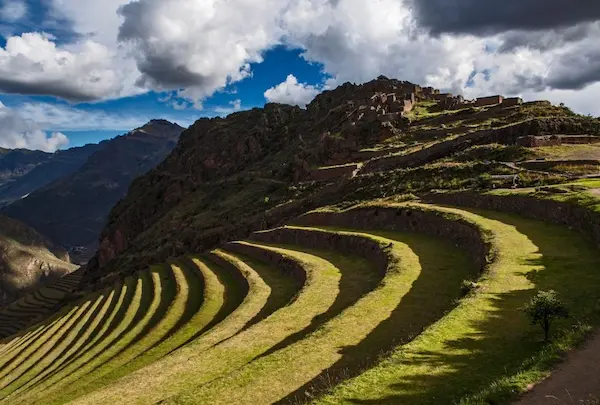
The Incas developed an agricultural system that allowed them to grow food in the challenging environment of the Andes. They built terraces on steep mountain slopes, created irrigation channels to distribute water, and selected crops according to the climate and altitude of each region. These techniques helped them make better use of available land, protect the soil, and maintain a reliable food supply for their communities.
Inca agriculture was based on understanding the natural conditions of the mountains and finding ways to work with them. Instead of depending on large areas of flat land, the Incas adapted their farming methods to different elevations, temperatures, and water sources. Their agricultural knowledge also included food preservation, soil management, and collective work, making farming an essential part of the organization of their empire.
These practices were not developed in isolation. They formed part of a long Andean agricultural tradition that included knowledge passed between generations and adapted to local environments. Through engineering and careful resource management, the Incas transformed difficult landscapes into productive agricultural areas.
How did the Incas develop agriculture in the Andes?
The Andes presented several challenges for agricultural production. Mountain slopes were often steep, temperatures changed considerably between elevations, and rainfall was not always distributed throughout the year. In some areas, rocky soil and limited water availability made cultivation even more difficult. These conditions reduced the amount of usable farmland and required techniques that could protect crops from environmental changes.
The Incas responded by adapting their farming methods to the characteristics of each region. They observed the landscape, identified suitable areas for cultivation, and developed agricultural structures to make better use of the land. They also considered altitude, temperature, and water availability when selecting crops, allowing them to take advantage of different environments across the mountains.
Agricultural production also required organization and cooperation. Communities participated in building terraces, maintaining irrigation channels, preparing the soil, and collecting harvests. These activities helped preserve agricultural areas and maintain a food supply throughout different seasons.
Their approach included different practices:
- Building terraces to create cultivation surfaces on mountain slopes.
- Developing irrigation systems to transport water to agricultural fields.
- Selecting crops according to altitude and environmental conditions.
- Improving soil drainage to reduce erosion and water accumulation.
- Organizing community labor to maintain agricultural infrastructure.
These practices worked together rather than functioning as separate solutions. Agricultural terraces provided suitable surfaces for cultivation, irrigation systems helped supply water, and crop selection allowed farmers to take advantage of different environmental conditions. At the same time, soil management protected the land and community cooperation supported the maintenance of agricultural infrastructure.
This combination allowed agricultural communities to use different parts of the landscape rather than depending on a single type of terrain. Mountain slopes, elevated valleys, and areas with different water conditions could become productive agricultural spaces when the appropriate techniques were applied. As a result, the Incas established a farming system that took advantage of the geographical diversity of the Andes and supported food production across different regions of their empire.
Agricultural terraces: Turning mountain slopes into farmland
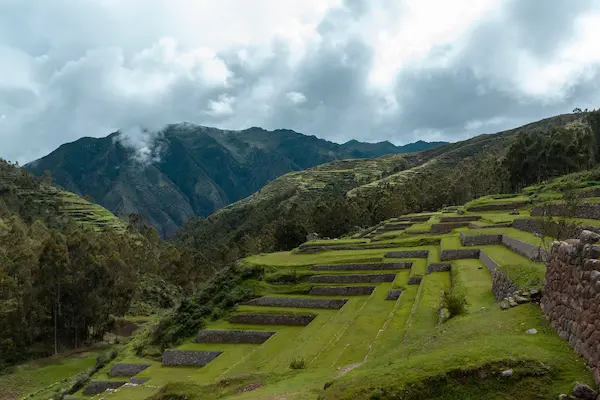
One of the most recognizable features of Inca agriculture was the construction of agricultural terraces, known in Quechua as andenes. These platforms were built along mountain slopes using retaining walls made mainly of stone. They allowed farmers to transform uneven areas into organized cultivation spaces, making better use of land that would otherwise have been difficult to farm. Their construction also demonstrated the Incas’ ability to adapt their architecture to the natural shape of the mountains.
The terraces created flatter surfaces where farmers could prepare the soil, plant crops, and manage water more effectively. Their construction required knowledge of the terrain because each platform had to remain stable despite the pressure of the soil and rainfall. The size and arrangement of the terraces depended on the slope and geographical conditions of each location. Some were built in long sequences along mountainsides, while others followed the natural shape of smaller hills and valleys.
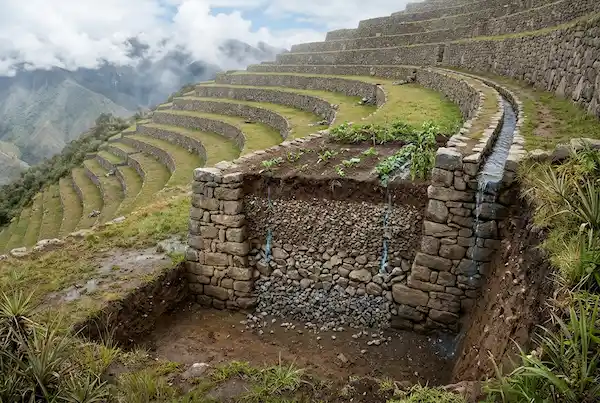
A traditional terrace could include several layers:
- Stone foundations: Provided support and stability for the structure.
- Gravel and smaller stones: Helped improve drainage and control excess moisture.
- Prepared soil: Created a suitable surface for growing different crops.
- Retaining walls: Kept the agricultural platform in place and reduced soil movement.
These layers worked together to make cultivation possible on slopes that would otherwise be difficult to use. Their arrangement helped maintain the structure by controlling moisture, improving drainage, and reducing pressure from accumulated water. This construction method allowed farmers to use several levels of a mountain while making better use of available space and creating stable surfaces for growing crops.
Terraces also helped reduce soil erosion by slowing the movement of rainwater and keeping fertile soil in place. Their platforms created different growing conditions depending on elevation, sunlight, and orientation, allowing farmers to select suitable crops for each area. As a result, they became an important solution for expanding agricultural land, protecting natural resources, and supporting food production throughout the Andes.
If you are interested in reading: Wiñay Wayna: History and architecture on the Inca Trail
Why were agricultural terraces important?
The importance of terraces went beyond creating more farmland. Their design helped manage several environmental conditions that affected agricultural production.
Among their main benefits were:
- Better use of land: They made steep mountain areas suitable for cultivation.
- Soil protection: Retaining walls helped reduce erosion caused by rainfall.
- Water control: Their structure contributed to drainage and moisture management.
- Different growing conditions: Terraces at different elevations offered opportunities to cultivate various crops.
Some terraces also created small differences in temperature and moisture between platforms. This allowed farmers to take advantage of local conditions when selecting crops. The construction of these structures demonstrates how agricultural engineering was connected to the natural geography of the Andes.
Water management and irrigation in Inca agriculture
Water was one of the most important resources for Andean agriculture. Although some regions received seasonal rainfall, others required additional systems to transport water to cultivated land. Changes in weather and differences in altitude affected its availability, making it necessary to develop methods that could support crops during drier periods. Without proper water distribution, agricultural production would have been more difficult, especially in areas located far from rivers and natural water sources.
The Incas developed irrigation infrastructure that connected rivers, springs, and other natural water sources with agricultural areas. These systems helped communities distribute water according to the terrain and the needs of their crops. Water management also involved controlling excess rainfall, protecting the soil, and maintaining channels and reservoirs throughout the year. By combining irrigation and drainage techniques, they were able to make better use of available water and protect cultivated land from changing environmental conditions.
How did Inca irrigation systems work?
Inca irrigation systems used channels and stone structures to transport water across different elevations. Many of these channels followed the natural slope of the landscape, allowing gravity to move water without the need for mechanical pumps. This method helped transport water from rivers and springs toward agricultural terraces, fields, and settlements. It was especially useful in mountainous areas where the uneven terrain made water distribution more difficult.
Their construction required careful planning and measurements. A channel needed an appropriate inclination to maintain a steady flow and avoid excessive water pressure. The Incas also considered the materials used in construction and the direction of the water flow to reduce leaks and prevent damage to the surrounding soil. These structures connected different parts of the agricultural landscape and helped communities make better use of available water.
Some important elements included:
- Stone irrigation channels: Guided water from natural sources toward agricultural areas.
- Water distribution points: Helped direct water to different fields and terraces.
- Reservoirs: Allowed water to be collected and stored for later use.
- Drainage channels: Helped remove excess water and protect cultivated land.
The maintenance of these systems required regular community participation. Channels could become blocked by sediment, stones, or vegetation, so keeping them functional was an important part of agricultural work. Communities also needed to inspect the structures and repair damaged sections to ensure that water continued reaching cultivated areas. This collective responsibility helped preserve irrigation infrastructure and supported agricultural production across different parts of the Andes.
If you are interested in reading: Sustainable Tourism in Peru
Soil conservation and rainwater management
Managing water also meant protecting the land from excessive moisture. During the rainy season, water could move quickly down mountain slopes, carrying fertile soil with it and damaging cultivated areas. This was a particular challenge in the Andes, where steep terrain increased the risk of erosion and made agricultural land more vulnerable to heavy rainfall. For this reason, the Incas developed techniques that helped control the movement of water and preserve the soil used for cultivation.
One of these techniques involved the construction of agricultural terraces with stone walls. These structures slowed down rainwater as it moved across the slopes and helped prevent large amounts of soil from being washed away. Inside the terraces, layers of gravel, sand, and stone improved drainage by allowing excess water to move through the ground. This reduced water accumulation and helped maintain more stable conditions for growing crops.
These techniques were especially useful in mountainous areas where agricultural platforms depended on stable foundations. Some of their main benefits included:
- Reducing the loss of fertile soil.
- Preventing excessive water accumulation.
- Improving the stability of agricultural terraces.
- Supporting cultivation during different seasonal conditions.
The combination of irrigation and drainage shows that Inca water management involved more than bringing water to crops. It also required protecting the soil, controlling excess rainwater, and maintaining the structures that supported agricultural production. By adapting these techniques to the conditions of the Andes, communities could preserve cultivated land and make better use of the available space. This balance between water distribution and soil conservation was an important part of how agriculture developed in the Inca world.
What crops did the Incas grow?
The Incas cultivated a wide variety of crops throughout their territory, developing an agricultural system adapted to the different environments of the Andes. Their production included tubers, grains, and legumes that provided food for local communities and supported the growth of the empire. The crops they grew depended on factors such as altitude, temperature, rainfall, and the characteristics of each region. These conditions influenced which plants could grow successfully and when they could be harvested.
Instead of growing the same products everywhere, communities selected crops according to the conditions of their environment. This allowed them to take advantage of different ecological zones, from cold highland areas to warmer valleys. By cultivating different types of food, they could reduce their dependence on a single crop and maintain a more varied food supply throughout the year. This diversity also helped communities adapt to changes in weather and the challenges of farming in mountainous landscapes.
Some important crops included:
| Crop | Role in Andean agriculture |
|---|---|
| Potatoes | Important food source adapted to cold and high-altitude environments. |
| Maize | Used for food, beverages, and ceremonial activities. |
| Quinoa | A traditional grain valued for its nutritional properties. |
| Oca | An Andean tuber cultivated in different highland environments. |
| Beans | Contributed to food diversity and agricultural production. |
| Kiwicha | Another traditional Andean crop used as food. |
How did altitude influence crop production?
Altitude played an important role in determining which crops could grow successfully in the Andes. As elevation increased, temperatures generally became colder, and growing conditions changed. Differences in temperature, sunlight, rainfall, and soil conditions influenced the development of each plant. Because of this, not all crops could be cultivated in the same areas, and farmers needed to understand how the environment affected agricultural production.
Farmers used their knowledge of these differences to select suitable areas for each crop. They observed the characteristics of the land and adapted their cultivation practices to the conditions of each elevation. This allowed them to make better use of the available agricultural space and grow different food products across the mountainous territory.
For example:
- Higher elevations were especially suitable for potatoes and other cold-resistant tubers.
- Temperate valleys offered favorable conditions for maize.
- Intermediate elevations allowed the cultivation of different grains, vegetables, and tubers.
- This diversity helped communities obtain different food products from several agricultural environments.
The Sacred Valley is an important example of the relationship between geography and agricultural production. Its combination of mountain slopes, river valleys, and varied elevations created conditions for different types of cultivation. The presence of warmer and cooler areas within the same region allowed farmers to grow a variety of crops and take advantage of the natural differences in the landscape. This shows how knowledge of altitude and local environmental conditions contributed to the development of agriculture in the Andes.
If you are interested in reading: What were the 12 Famous Inca artifacts of the Inca Empire?
Food preservation and storage in the inca empire
Agricultural production did not end with harvesting crops. The Incas also needed to preserve food and organize its storage to ensure that communities had supplies during periods when fresh products were less available. This was especially important in the Andes, where changes in weather, seasonal conditions, and the difficulty of transporting food between regions could affect its availability. Preserving agricultural products helped reduce waste and maintain food reserves for different needs.
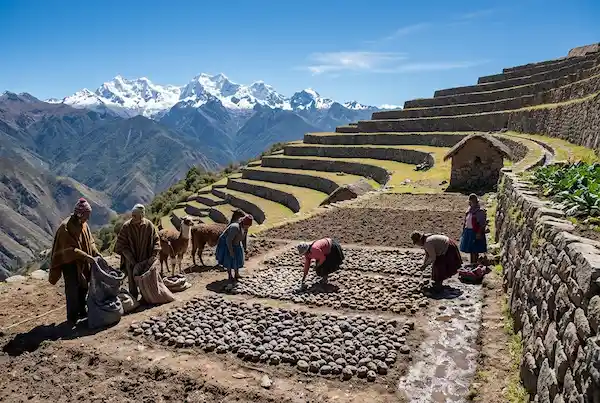
One of the best-known preservation techniques was the production of chuño, a traditional food made from potatoes. This process took advantage of the cold temperatures and strong sunlight of the Andean highlands to remove moisture from the tubers. Potatoes were exposed to freezing conditions during the night and sunlight during the day. They were then pressed to remove excess water and left to dry until they could be stored for extended periods.
This technique made potatoes lighter, easier to transport, and more durable than fresh ones. Once preserved, chuño could be stored and used when fresh food was harder to obtain. It was also an important way to make use of the natural climate of the highlands without relying on complex equipment.
What were qollqas and how were they used?
The Incas also constructed storage facilities known as qollqas. These buildings were used to preserve agricultural products, dried foods, and other supplies after the harvest. They formed an important part of the empire’s food distribution system because they allowed communities and authorities to keep provisions available for future use. By storing surplus production, the Incas could prepare for periods when crops were not being harvested or when certain regions needed additional supplies.
Qollqas were often built in strategic locations, including elevated areas and places where environmental conditions helped preserve stored food. Their construction and arrangement varied depending on the region and the products being stored. Factors such as ventilation, temperature, and protection from moisture were considered to reduce deterioration and keep supplies in suitable conditions. This made the storage facilities an important complement to agricultural production and food preservation techniques.
Qollqas played several important roles:
- Storing crops after the harvest.
- Maintaining food supplies for different periods of the year.
- Supporting communities during shortages.
- Providing provisions for workers and the administration of the empire.
Food storage was essential for organizing agricultural production on a larger scale. It allowed the Incas to keep surplus crops available and distribute provisions when communities faced shortages or when fresh products were not readily accessible. These reserves also helped supply workers involved in construction, agriculture, and other activities across the empire. In this way, qollqas helped connect farming communities with the wider economic and administrative structure of the Inca Empire, supporting the movement and distribution of food between different regions.
The role of community work in inca agriculture
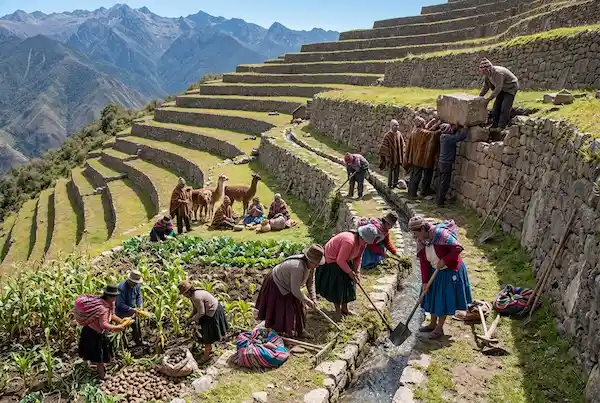
Agricultural production depended on more than terraces, irrigation channels, and suitable crops. It also required the participation of communities that worked together to prepare the land, maintain infrastructure, plant seeds, and collect harvests. Many agricultural activities involved large areas of land or structures that could not be maintained by a single family. For this reason, cooperation was an important part of everyday life in the Andes and helped communities organize their agricultural responsibilities.
The Incas organized different forms of collective labor that allowed people to complete tasks requiring the participation of many individuals. These practices helped distribute work among community members and ensured that important activities could be carried out at different times of the agricultural cycle. Two important concepts associated with this organization were minka and ayni, which reflected different ways of cooperating and supporting one another.
Minka: Collective work for the community
Minka was a form of collective work carried out for the benefit of the community. People participated in activities such as maintaining irrigation channels, constructing agricultural structures, repairing terraces, and improving shared spaces. These tasks required the participation of several families, who contributed their time and effort to projects that benefited the wider community rather than just one household.
This cooperation was especially important because agricultural infrastructure required continuous attention. A damaged irrigation channel or an unstable terrace could affect the production of an entire area. Through minka, communities could organize work to repair these structures, prepare agricultural land, and maintain the conditions needed for cultivation. It also helped ensure that responsibilities were shared among community members.
Ayni: Reciprocity and mutual support
Ayni was based on reciprocity and mutual support between families and community members. It involved helping others with different activities, with the understanding that this support would be returned when needed. In agriculture, this could include helping with planting, harvesting, or preparing the land when a family needed additional labor. For example, a family could receive help from its neighbors during the harvest and later offer the same support when those neighbors needed assistance. This exchange made it easier to complete demanding agricultural tasks and strengthened relationships between households.
While minka focused on collective work for the benefit of the community, ayni was based on mutual assistance between families and individuals. Both practices show how agriculture in the Inca Empire depended not only on knowledge of the land and natural resources but also on cooperation and shared responsibilities. Through these forms of work, communities could organize agricultural activities, support one another, and maintain the social relationships that helped sustain production across the Andes.
Where can you still see the agricultural legacy of the Incas?
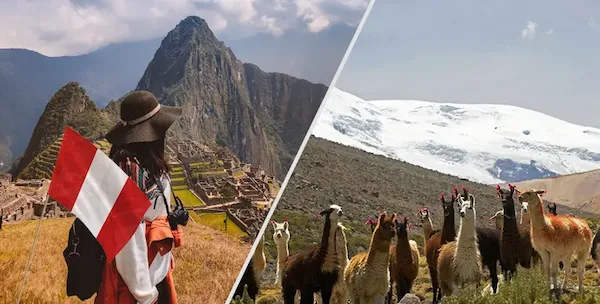
Several archaeological sites in Peru preserve evidence of the agricultural knowledge developed by the Incas. Places such as Ollantaytambo, Pisac, and Wiñay Wayna feature agricultural terraces, irrigation structures, and stone constructions adapted to the mountainous terrain. These remains show how ancient communities used the available space, managed water resources, and developed cultivation areas despite the challenges of the Andean landscape.
The Sacred Valley also preserves landscapes that reflect the relationship between agriculture and the natural environment. Its archaeological sites, traditional agricultural areas, and mountain terraces help visitors understand how the Incas adapted their farming practices to different elevations and geographical conditions. Exploring this region through a private tour through the Sacred Valley offers an opportunity to visit important Inca sites and appreciate the connection between their architecture, agricultural knowledge, and surrounding mountains.
The agricultural knowledge that continues to shape the Andes
The Incas transformed the challenges of the Andean landscape into opportunities for agriculture. Through terraces, irrigation systems, crop diversity, and food preservation techniques, they developed ways to cultivate the land and make use of available resources. Their achievements were not based on a single technique but on a combination of knowledge, planning, and community cooperation.
Today, their agricultural legacy can still be seen in the terraces and structures that remain across the Andes. These examples show how understanding the natural environment can shape the way communities live and produce food. The knowledge developed by the Incas remains part of the history of the Andes and a reminder of how closely agriculture, culture, and the land are connected.


